What Happens During Padel Court Construction? A Step-by-Step Guide
Planning permission is a milestone, but the padel court construction process still requires groundworkers, engineers, court manufacturers, installers and electricians to work in sequence. The method depends on the site and court system, but most UK projects follow similar stages.
1. Pre-start checks and setting out
Before work begins, the contractor should review planning conditions, drawings, site information and the agreed scope. Access, deliveries, waste removal, responsibilities and the construction programme should be clear.
The court position is then marked out. This confirms its orientation, footprint, levels, clearances and relationship with paths and boundaries. Differences between drawings and actual site conditions should be resolved before excavation starts.
2. Site clearance and ground preparation
The area is cleared of vegetation, existing surfacing and unsuitable material. Topsoil is stripped or stored as required. The contractor establishes formation level and checks the ground. Unexpectedly weak or wet conditions may require a change to the design or method, so assumptions should be identified before pricing. Our groundworks service covers this preparation.
3. Drainage and underground services
Drainage must be planned as part of the build, not added afterwards. Water needs a suitable route away from the playing area and surrounding hardstanding, taking account of levels, ground conditions and the available outfall.
Ducts for electrical cables may also be installed now. Routes for court lighting and controls are easier to coordinate before the base and surrounding surfaces are complete.
4. Sub-base, foundations and concrete base
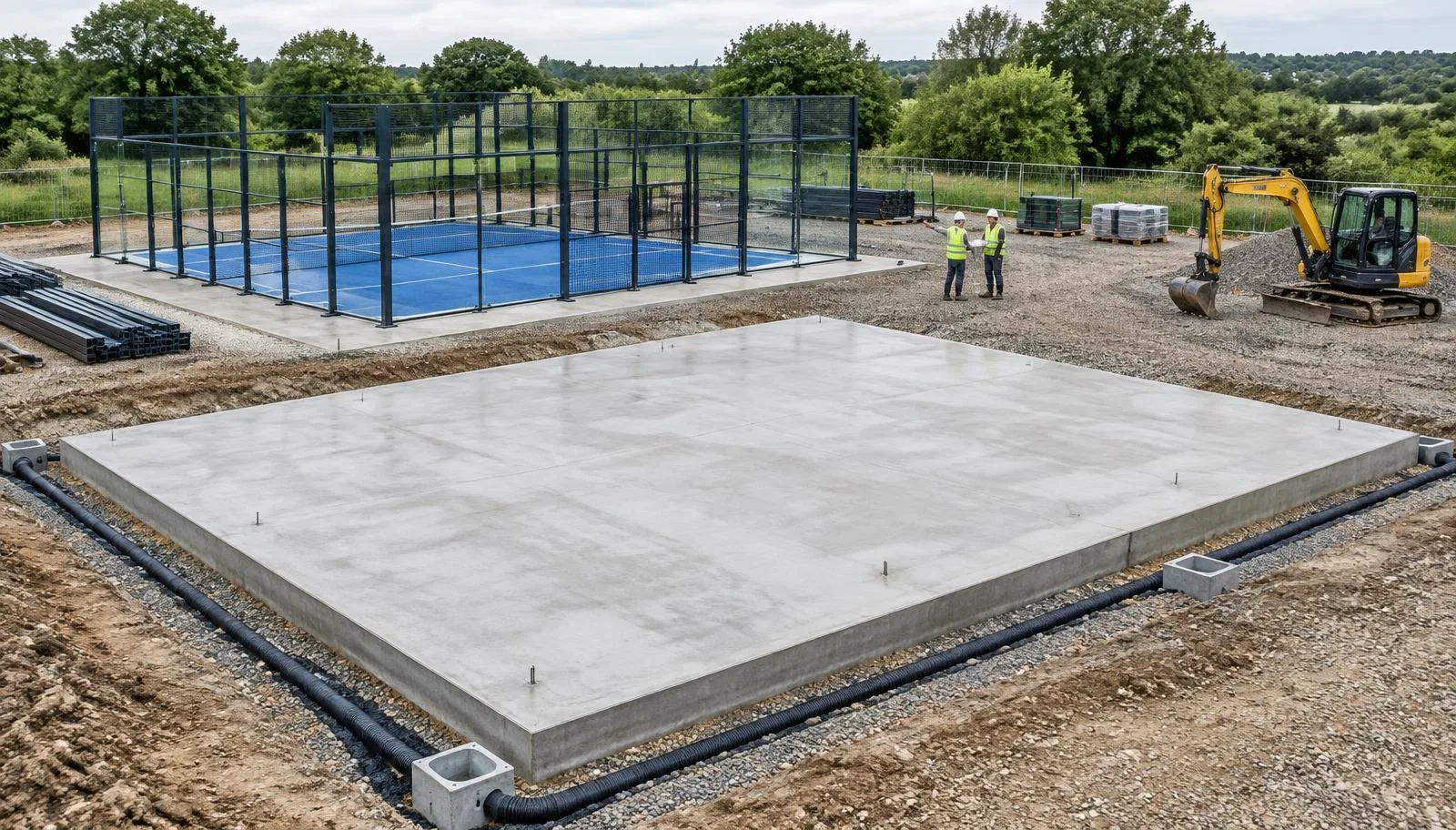
After the ground is compacted, the specified sub-base and foundation system is installed. This may be a reinforced concrete slab, perimeter ring beam or another engineered arrangement.
There is no universal detail: the design must reflect ground conditions, manufacturer requirements and structural loads such as wind, while coordinating drainage and fixing points. See our groundworks and foundations guide.
Accuracy is critical. The finished base must meet specified levels, dimensions and tolerances so the steel structure, glass and playing surface can be installed correctly. A base that is out of level can cause delays and problems later, regardless of the quality of the court equipment.
5. Court structure, glass and fencing
Once the base has been checked, the court components can be delivered and installed. The steel framework is assembled and fixed to the designed foundation points. Glass panels, mesh sections, doors and fittings follow in the sequence specified by the manufacturer.
Glass is heavy and must be handled and secured correctly. The installer follows the manufacturer's instructions and checks alignment, fixings and clearances. Our court supply and installation service coordinates this stage.
6. Artificial turf, net and lighting
The specified padel turf is fitted, cut and secured to suit the court system. Sand infill is distributed and brushed through the pile, and the net is installed and adjusted.
Lighting is connected in accordance with the electrical design. Fittings should be aimed and checked to provide suitable illumination while controlling light spill beyond the site.
7. Testing, handover and aftercare
Before opening, the completed court should be inspected against the agreed specification. Checks should cover the structure, glass, fixings, doors, turf, net, lighting, drainage and access works. Electrical testing and other required checks should be completed by competent people.
Handover should include warranties, product information, maintenance instructions, inspection recommendations and details of who to contact if defects arise. Make sure responsibility for the court, foundations, installation and separate electrical or groundworks packages is clear. Our maintenance and repairs service supports ongoing care.
From planning permission to a finished court
A successful padel court installation UK project depends on more than ordering a court. Ground conditions, drainage, foundations, access, electrical infrastructure and contractor coordination all affect cost and programme. Before appointing anyone, compare quotations on the same scope. Check inclusions, exclusions, trade responsibilities, variation terms and warranties; a low headline price may not cover the complete facility.
If you already have planning permission, drawings or contractor quotations, the next step is to turn them into a deliverable construction package. Build & Padel can review your information, identify gaps in scope and help develop a clear proposal for procurement and delivery through our padel court construction service.
Already Have Planning Permission? Let's Get Your Padel Project Built.
You've secured planning permission. Now make sure your construction scope, specification and contractor arrangements are right. Build & Padel can review your existing drawings, specifications and quotations and help you move towards procurement and delivery.