Padel Court Foundations Explained: Concrete Bases, Ring Beams and Ground Conditions
A padel court might look relatively simple once installed, but what sits beneath it can have a significant impact on the project's cost, construction time and long-term performance.
Getting padel court foundations right is about more than pouring concrete. The ground must provide suitable support, drainage must be properly managed and the finished base must meet the levels and tolerances required by the court manufacturer.
For anyone planning a new padel facility, understanding the options for a padel court concrete base is an important part of budgeting and site preparation.
Why do padel courts need properly designed foundations?
A padel court combines a steel structure, glass panels, mesh, artificial turf and lighting. These components need a stable and accurately prepared supporting base.
Poor foundations can lead to problems with alignment, drainage, movement and installation. Even relatively small variations in finished levels can make it difficult to assemble the court correctly and achieve the required tolerances.
The foundations also need to suit the loads imposed by the court structure and local conditions. This is particularly important for outdoor installations exposed to wind and changing weather.
There is no universal foundation design suitable for every site. The correct solution should be established before groundworks begin.
Padel court concrete base: full slab or ring beam?
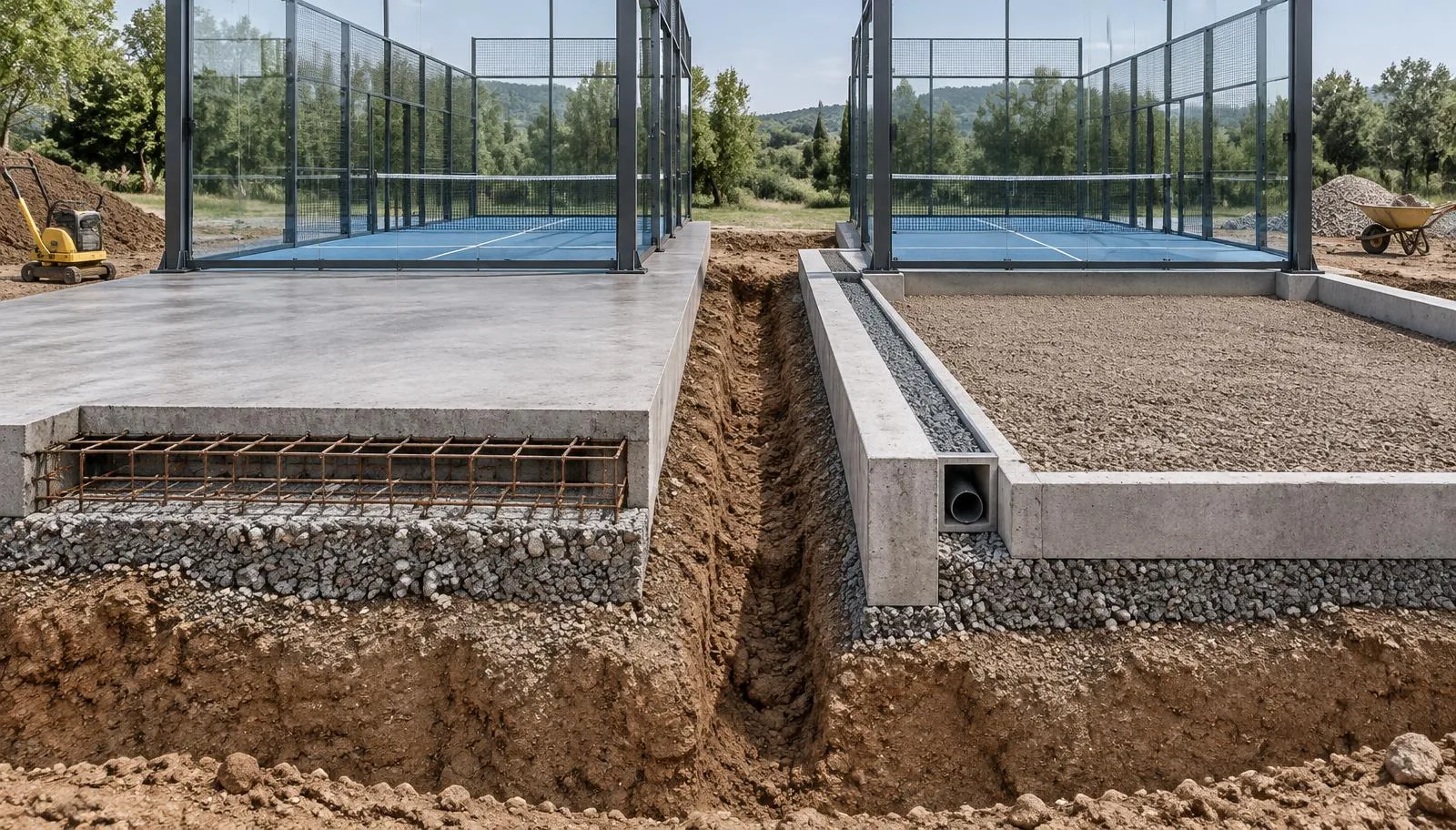
Two approaches commonly considered for padel court foundations are a full concrete slab and a perimeter foundation or ring beam arrangement.
Full concrete slab
A full reinforced concrete slab provides a continuous base beneath the court. It can offer a suitable installation surface when correctly designed, constructed and finished.
The advantages include a consistent supporting surface and the potential to simplify certain aspects of setting out and installation.
However, a full slab can involve substantial excavation, material quantities, reinforcement and associated drainage work. Its suitability depends on the ground, design loads, drainage strategy and intended court system.
Ring beam foundations
A ring beam is a reinforced concrete foundation constructed around the perimeter of the court, providing support for the structure at the required fixing locations.
Depending on the engineered design and court system, the internal playing area may use a separately constructed surface or supporting build-up.
Ring beam arrangements can reduce the quantity of concrete compared with a full slab in some circumstances. However, they are not automatically cheaper or suitable for every project.
The design must account for structural loads, ground bearing capacity, fixings, settlement risk and the relationship between the perimeter foundation and the playing surface.
Which option is better?
Neither approach is universally superior. The decision should be based on the site investigation, structural requirements, drainage design and manufacturer specifications.
Choosing a foundation simply because it was used successfully on another project is not a substitute for proper design.
How do ground conditions affect padel court foundations?
Ground conditions can make a considerable difference to construction costs.
A site with suitable existing hardstanding may require less excavation than an undeveloped field. However, an existing surface should never be assumed suitable without checking its condition, thickness, levels and supporting structure.
Other ground conditions that may affect the design include:
- Clay soils: Can experience seasonal volume changes and movement.
- Made ground: May contain inconsistent materials or poorly compacted fill.
- Rock: Can increase excavation costs and affect construction methods.
- Poor bearing capacity: May require additional ground improvement or a different foundation design.
- Groundwater: Can affect excavation, drainage and construction methods.
- Sloping sites: May require additional earthworks, retaining structures and level adjustments.
A ground investigation can identify potential problems before the construction specification and budget are finalised. Our site feasibility review helps identify the early checks a project needs.
Why drainage and levels matter
Foundations cannot be considered separately from drainage.
Water needs to move away from the court and its supporting layers. Poor drainage can result in standing water, deterioration of the playing environment and problems within the underlying construction.
The design should consider surface falls, drainage channels, sub-base drainage and an appropriate discharge or attenuation solution.
Accurate setting out is equally important. The finished foundation must meet the court manufacturer's requirements for dimensions, fixing positions, flatness and level tolerances.
Getting these details right before installation helps avoid remedial work and unnecessary delays. Our groundworks and foundations guide covers the wider coordination considerations.
What should you budget for?
When estimating padel court foundations, do not consider concrete as an isolated material cost.
A realistic groundworks allowance may include:
- Site clearance and excavation.
- Removal and disposal of excavated material.
- Ground investigation and engineering design.
- Sub-base preparation and compaction.
- Reinforcement and concrete.
- Drainage and water management.
- Setting out, levels and quality checks.
- Access requirements and contractor mobilisation.
The final cost will depend on the site, chosen foundation system, number of courts and scope of associated works. See our UK padel court cost guide for the distinction between court supply and the complete project budget.
Get the foundations right before pricing your padel project
A padel court is a significant investment, and the foundations are one area where early planning can prevent expensive surprises later.
Before committing to a court supplier or construction contractor, understand the ground conditions, drainage requirements and likely cost of preparing the site.
Build & Padel takes a construction-led approach to padel developments, considering groundworks, foundations, drainage and court installation as connected parts of the same project.
Want to understand the full cost of developing a padel facility?
Explore our UK Padel Development Cost Guide for a breakdown of court supply, groundworks, foundations, drainage, lighting, infrastructure and other costs that need to be considered when planning your project.
Explore the Padel Development Cost Guide