Indoor vs Outdoor Padel Courts: Which Is the Better Investment?
Choosing between indoor and outdoor padel courts is one of the most important decisions when planning a padel facility. The right option can influence construction costs, playing hours, customer demand and the long-term financial performance of the venue.
In the UK, weather is an important consideration, but it is not the only one. Indoor courts can offer more consistent playing conditions, while outdoor courts generally require less initial investment. The best choice depends on your site, local demand, available capital and business model.
1. Initial construction costs
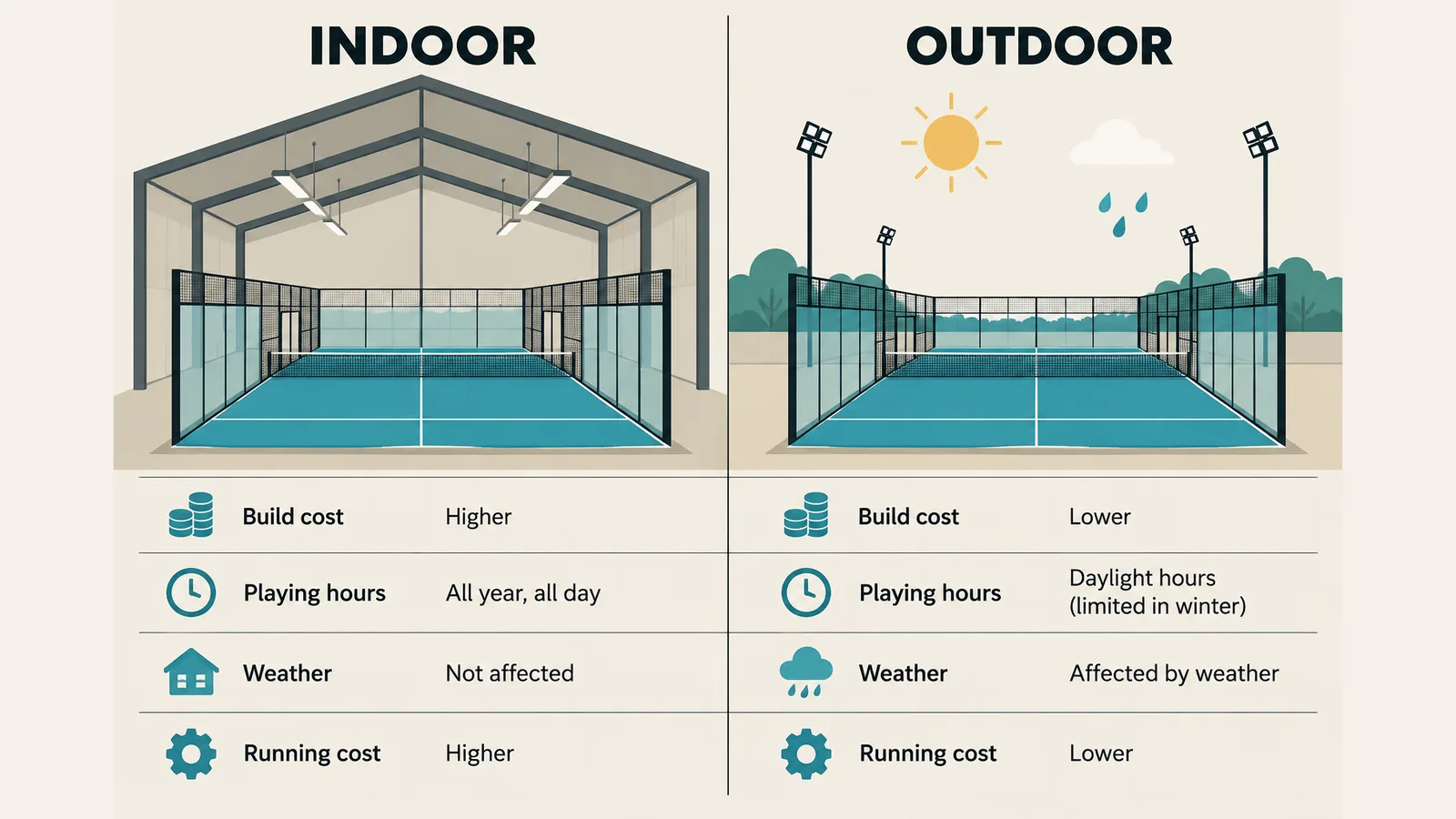
Outdoor padel courts are generally the more affordable starting point. They do not require a complete indoor building, although they still need suitable foundations, drainage, court structures, lighting where required and appropriate access.
Indoor courts introduce additional costs. Depending on the project, these can include a building or covered structure, structural engineering, electrical infrastructure, lighting, ventilation, heating and associated facilities. Our padel court cost guide explains how court packages, installation and full projects differ.
Ground conditions can significantly affect the cost of either option. Drainage, earthworks, access improvements and foundation requirements should be assessed before comparing headline court prices — see our groundworks and foundations guide.
What this means for investors: Outdoor courts can reduce the initial capital requirement. Indoor facilities require greater upfront investment, so the additional playing hours and potential revenue need to justify that difference.
2. Weather, seasonality and playing hours
British weather can make outdoor court utilisation less predictable. Rain, wind, colder conditions and reduced winter daylight can affect bookings and the customer experience.
Floodlighting can extend outdoor playing hours, but it does not eliminate disruption from poor weather. A covered court may provide a useful middle ground, depending on its design and the level of weather protection it offers. The practical site and building requirements for each option are covered in our indoor vs outdoor padel courts guide.
Indoor padel courts provide more consistent conditions throughout the year. Players can book with greater confidence, and operators may find it easier to maintain leagues, coaching sessions and organised events during winter.
However, reliable playing conditions do not automatically guarantee high occupancy. Local demand, pricing, competition and effective marketing still determine how many hours are sold.
3. Revenue potential and utilisation
The commercial case for indoor padel is largely about utilisation: the proportion of available court hours that customers actually book.
An indoor facility may be able to sell more hours consistently, particularly during poor weather and winter months. It may also offer a more dependable environment for coaching, competitions and regular bookings.
Outdoor facilities can still perform well where demand is strong, the location is accessible and the customer base is willing to play outside. Their lower capital requirements can also make them attractive, even if some playing hours are lost to weather.
The important question is not simply which court can charge the highest hourly rate. It is how much revenue each court can generate across realistically saleable hours.
A useful starting point is:
Court revenue = number of courts × available hours × utilisation × average achieved hourly price.
Use realistic assumptions rather than assuming every available hour will be sold at the advertised peak rate.
4. Running costs and maintenance
Outdoor courts can have lower building-related running costs, but they still require regular maintenance. Weather exposure, debris, surface care, drainage and lighting all need consideration. Our padel court maintenance and repairs service covers this ongoing care.
Indoor courts avoid direct weather exposure but introduce additional responsibilities. Building maintenance, ventilation, heating where provided, electricity and internal facilities can increase ongoing expenditure.
Energy consumption deserves particular attention. A large indoor facility may have substantial costs beyond the courts themselves, especially where heating and other building services are required.
When comparing options, consider both routine expenditure and longer-term replacement and repair costs.
5. Planning, site suitability and expansion
Planning requirements depend on the proposed development and the site. Outdoor courts can raise issues involving lighting, noise, visual impact, drainage and neighbouring properties.
Indoor developments may introduce further considerations relating to building size, design, access, parking and the proposed use of the site.
Neither option should be assumed to have automatic planning approval. Early assessment of the location and relevant planning requirements can help identify potential constraints before significant money is committed — read do you need planning permission for padel courts?
Your available land, existing buildings, utilities, access and opportunities for future expansion should all influence the decision. A padel site feasibility review can test these factors for your site.
6. So, which is the better investment?
From an investment point of view, the answer comes down to return on capital rather than court type alone.
Outdoor courts may suit landowners, existing sports clubs and operators seeking a lower-cost entry point, particularly where the location has strong demand and suitable playing conditions.
Indoor courts may be more attractive where year-round utilisation is essential, the local market supports consistent bookings and the additional capital and operating costs can be justified.
A covered option may also be worth investigating where it offers a suitable compromise between weather protection and construction expenditure.
The strongest investment decision comes from comparing realistic revenue, capital expenditure, operating costs and downside scenarios for the actual site.
Model your padel investment before committing
Before deciding between indoor and outdoor courts, it is worth understanding how court numbers, booking rates, utilisation, seasonal demand and construction costs affect the commercial picture.
Explore our Padel ROI & Revenue Guide to examine the key variables behind padel facility revenue and test illustrative assumptions for your proposed development.
A realistic model, supported by an assessment of your site and development costs, can help you make a more informed decision.
Related reading
For a site, construction and operating comparison, see our indoor vs outdoor padel courts guide.
All Padel Court Articles & Insights · Padel guides and resources