How Long Does It Take to Build a Padel Court in the UK?
One of the first questions when planning a padel facility is when the courts will be ready for players. Understanding padel court installation time helps with finance, contractor coordination, launch plans and forecasting when the venue can start generating revenue.
The answer depends on the site, court numbers, ground conditions and whether planning permission is secured. Court assembly can be relatively quick, but the complete construction programme involves several connected stages.
How long does it take to build a padel court?
For a straightforward outdoor project with planning secured, an initial allowance is around 8–16 weeks from procurement to opening. This is a planning estimate, not a guaranteed programme.
Manufacturing, delivery and site works may overlap. The stage allowances below should not simply be added together, and longer supplier lead times can push the total beyond this range. Complex sites, multi-court developments and covered facilities may take several months.
The physical construction period is generally shorter than the overall project timeline. Preparing the ground, coordinating drainage and waiting for equipment can take considerably longer than assembling the steel structure and glass panels.
The main stages of a padel court construction timeline
These indicative allowances need confirmation against the chosen court system and site-specific programme.
1. Final design and procurement
Typical allowance: 1–3 weeks for design and specification, plus supplier lead time.
Agree court positioning, structural requirements, glass, turf, lighting and supporting facilities. A practical site layout helps coordinate these decisions.
Allow approximately 4–14 weeks for manufacturing and procurement, depending on specification and availability. Confirm dates with the supplier. Orders must match approved drawings and relevant planning conditions.
2. Site preparation and groundworks
Typical allowance: 2–4 weeks.
Works may include clearance, excavation, levelling, soil removal, formation preparation, drainage and service ducts. Suitable hardstanding can reduce preparation; sloping land, poor ground or inadequate drainage can add work. An early site assessment helps identify these risks before committing.
3. Foundations and court base
Typical allowance: 1–3 weeks, depending on design and ground conditions.
The base must support the structure and meet specified levels, tolerances and fixing positions. Foundation design depends on engineering and manufacturer requirements. Allow for concrete curing and approval before assembly; do not assume every base is ready immediately.
4. Court structure and glass installation
Typical allowance: approximately 3–7 working days per court.
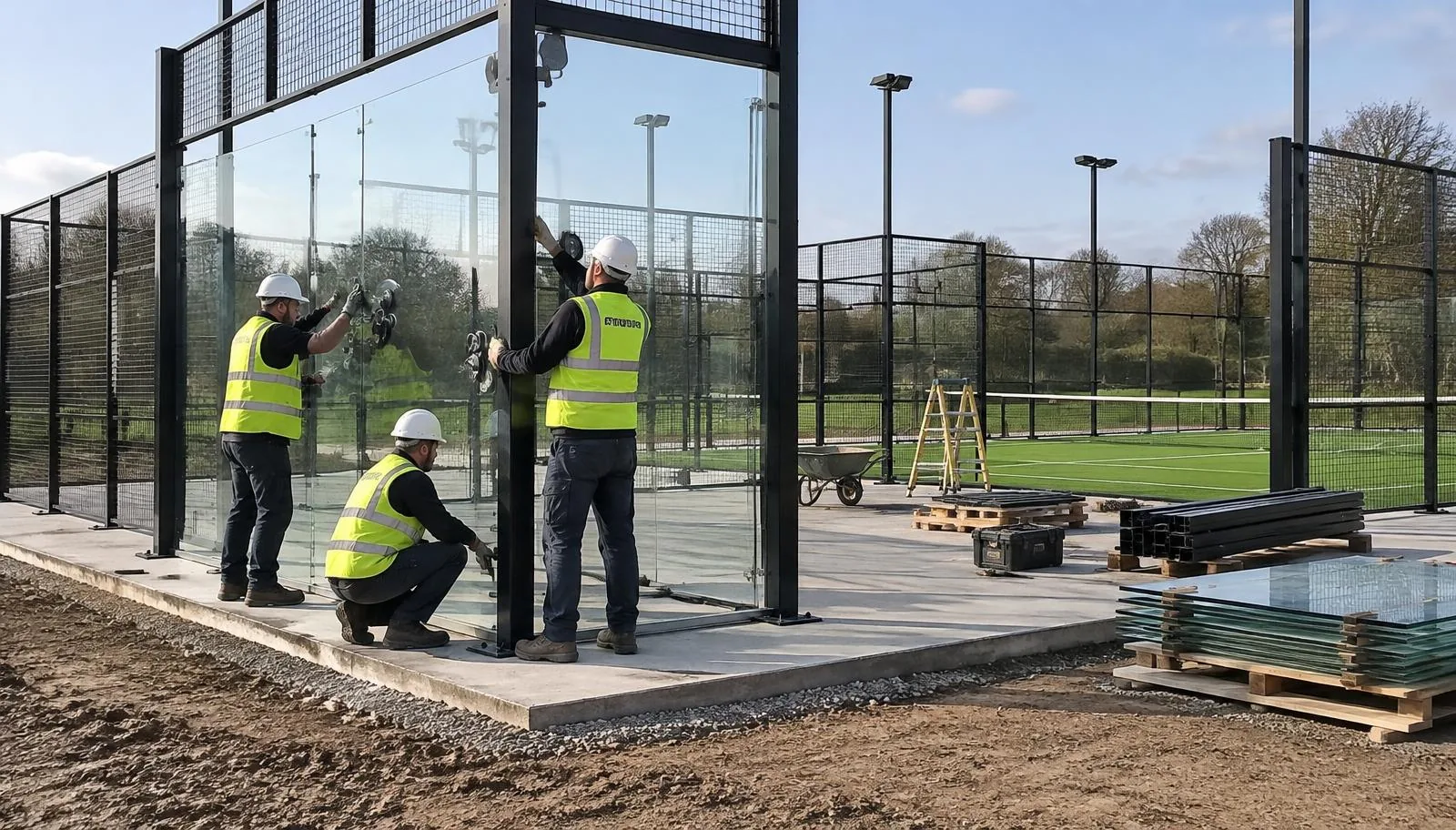
Once the base is accepted and equipment delivered, specialist installers assemble the steel framework, glass and enclosure. Duration depends on the system, access, team and court numbers. Multiple courts may progress in parallel where labour and equipment permit.
5. Artificial turf, lighting and finishing
Typical allowance: 1–2 weeks, with some activities overlapping installation.
Turf and sand infill are completed, lighting connected and checked, and fencing, gates and surroundings finished. Access routes, safety features, landscaping and spectator areas also need coordination before opening.
6. Testing and handover
Typical allowance: several days to one week.
Inspect the playing surface, glass, structural fixings, lighting, drainage and general safety. Provide warranties, maintenance information, operating instructions and required handover documentation before the operator accepts the facility.
What can delay padel court installation?
Common causes include:
- Ground conditions: Unexpected soil, drainage problems or extra excavation.
- Weather: Heavy rain affecting excavation, concrete and external works.
- Equipment availability: Manufacturing or delivery delays.
- Planning conditions: Outstanding approvals or undischarged conditions.
- Contractor coordination: Poor sequencing between different trades.
- Site access: Restricted deliveries or limited working hours.
How can you get your padel courts built faster?
Coordinate procurement, groundworks and installation before starting. Finalise specifications, confirm lead times, check planning conditions and arrange access early.
Ordering early can reduce waiting time, but only after the final specification is agreed. Confirm which activities can overlap and who is responsible for each stage, so groundworkers, electricians and specialist installers work to the same programme.
Where practical, procurement and groundworks can run in parallel, but the base must meet the required specification before assembly. A coordinated team helps prevent downtime and disputes between contractors; speed should never replace quality checks.
Planning permission secured? Get your padel project moving.
Approval is an important milestone. Next, turn the proposal into a deliverable project with clear specifications, procurement arrangements, groundworks and an installation programme. Build & Padel can coordinate the practical requirements needed to move from approved plans towards construction.
Already Have Planning? Let's Get Building